 how-to
Minimum Ceiling Height for a Golf Simulator: 2026 Guide
Table of Contents
- How to Determine Minimum Ceiling Height for a Golf Simulator
- Absolute Minimum vs. Recommended Height: What the Numbers Actually Mean
- Golf Simulator Room Dimensions: Width, Depth, and Overhead Clearance
- How Swing Plane and Golfer Height Affect Required Ceiling Height
- Best Golf Simulator for Tight Spaces: What to Look For
- Measuring Your Swing Arc and Testing Clearance Before You Install
- Safety Buffer, Danger Zone, and DIY Ceiling Protection
- Frequently Asked Questions
Last Updated: September 13, 2026
How to Determine Minimum Ceiling Height for a Golf Simulator
The minimum golf simulator ceiling height is 9 feet for most golfers using a driver, though taller players or those with a steep swing plane may need 10 feet or more. This guide breaks down exactly how to measure your space and swing before you commit to a setup. At mygolfsimulator.shop we’re committed to being available to help you determine whether your space is sufficient for a simulator on an actual live phone call or through texts with pictures.
Start with your driver. It's the longest club in your bag, and it creates the highest apex point of any swing you'll make indoors. If you clear your driver, you clear everything else.
Here's what most guides get wrong: they quote a single number and stop there. Your required golf simulator ceiling height depends on your height, your swing plane, your hitting mat thickness, and how close you stand to the screen. Below, we'll show you exactly how to calculate your specific number.
The Three Measurements You Need Before Buying Anything
You need three numbers before you buy a single piece of equipment: your standing height, your driver length, and your vertical clearance at the highest point of your follow-through.
A common mistake is measuring only the room and ignoring the swing. A 9-foot ceiling works for a 5'9" golfer with a flat swing. That same ceiling fails for a 6'4" player with a steep downswing.
Grab a tape measure and note these:
- Your height in bare feet
- Your driver length from grip to sole
- Floor-to-ceiling height at your planned hitting position
- Thickness of your hitting mat
That last item matters more than most people realize. A thick mat raises your effective floor level, which reduces your usable overhead clearance.
Absolute Minimum vs. Recommended Height: What the Numbers Actually Mean
The absolute minimum ceiling height for a golf simulator is 8.5 feet, but this only works for shorter players with flat swings and short clubs. The recommended height is 10 feet, which accommodates most golfers, most clubs, and most swing types without constant worry.
Think of it this way. The absolute minimum is the number where you can swing without contact. The recommended height is the number where you can swing without thinking about contact. Those are very different experiences.
Ceiling Height | Who It Works For | Risk Level |
|---|---|---|
8.5 ft | Short players, irons only | High |
9 ft | Average height, flat swing | Moderate |
9.5 ft | Most golfers, most clubs | Low |
10 ft+ | Tall golfers, steep swing plane | Minimal |
If you're building a dedicated room, aim for 10 feet. If you're working with an existing garage or basement, measure carefully and adjust your club selection or hitting position.
Golf Simulator Room Dimensions: Width, Depth, and Overhead Clearance
A functional golf simulator room needs at least 10 feet of width, 15 feet of depth, and 9 feet of overhead clearance. These are the three dimensions that determine whether your setup works, and ceiling height is only one piece of the puzzle.
Width matters for your backswing and follow-through. If you're too close to a wall, you'll shorten your swing without realizing it. Depth matters for ball flight and launch monitor tracking. Radar-based units need more space behind the ball than camera-based systems.
Overhead clearance is where most installations fail. A room can be 20 feet wide and 25 feet deep, but if the ceiling is 8 feet, you're limited to irons and wedges.
Why Floor Mats and Hitting Mats Change Your Effective Height
A 2-inch hitting mat reduces your effective ceiling height by 2 inches. That sounds minor until you're swinging a driver at full speed.
Here's the math. If your ceiling is 9 feet (108 inches) and your mat is 2 inches thick, your effective floor-to-ceiling distance is 106 inches. Your swing arc needs to fit inside that reduced space.
Thicker mats, common in premium setups, can run 3 to 4 inches. Turf-topped mats with foam backing add even more. Always subtract mat thickness from your ceiling measurement before deciding if your space works.
How Swing Plane and Golfer Height Affect Required Ceiling Height
Your swing plane determines how high your clubhead travels, and it matters more than your height alone. A steep swing plane sends the club higher on the follow-through. A flat swing keeps it lower. Two golfers the same height can need different ceiling heights, and the one with the steeper plane needs more room.
Most guides stop there and hand you a single number. That number is a guess. What follows is the actual geometry, so you can calculate your own requirement instead of borrowing someone else's.
The Variables That Set Your Apex Height
Four measurements drive how high your clubhead climbs:
- Standing height. Taller golfers have longer arms and a longer swing radius, which raises the apex even with an identical plane angle.
- Driver length. A standard men's driver runs about 45 to 46 inches; a women's driver runs about 43 to 44 inches. Every extra inch of shaft raises the apex.
- Swing plane angle. Measured in degrees from horizontal, this is the single most underrated variable. A flat swing might sit near 45 degrees; a steep, upright swing can exceed 60 degrees.
- Distance from the ball to the ceiling obstruction. You swing under the lowest point above your hitting position, not the average ceiling height.
A Working Formula for Apex Height
You do not need a launch monitor to get close. Use this approximation:
Apex height ≈ (driver length + arm length) × sin(swing plane angle) + standing height
Where arm length is roughly your standing height multiplied by 0.44, and swing plane angle is your best estimate from a slow-motion video (see the measuring section below).
Worked example for a 6'2" golfer with a 45.5-inch driver and a 55-degree plane:
- Arm length ≈ 74 inches × 0.44 ≈ 32.6 inches
- Driver length + arm length ≈ 45.5 + 32.6 ≈ 78.1 inches
- 78.1 × sin(55°) ≈ 78.1 × 0.819 ≈ 64 inches
- Plus standing height (74 inches) ≈ 138 inches
That 138-inch figure is the theoretical apex of the clubhead at the top of the backswing. Subtract your mat thickness, add your safety buffer, and you have your real ceiling requirement. For this golfer, a 9-foot ceiling (108 inches) is nowhere close, which is exactly why the generic "9 to 10 feet" advice fails tall players.
Why Tall Golfers Get Hit Twice
Tall golfers face a compounding problem. Longer arms and a longer driver create a higher apex, and many tall players naturally develop a steeper swing plane to compensate for their build. Both variables push the clubhead higher at the same time.
If you are 6'2" or taller, do not trust a rule of thumb. Run the formula, then verify it with slow-motion video. Tall golfers should also consider choking down on the driver for indoor sessions, or switching to a shorter shaft for simulator work. Losing a few yards of distance beats cracking a ceiling joist.
Flattening Your Plane Without Rebuilding Your Swing
You do not have to overhaul your mechanics to fit a low ceiling. Small adjustments lower the apex measurably:
- Choke down one to two inches on the driver. This shortens the swing radius directly.
- Move the ball slightly forward in your stance to encourage a shallower attack angle.
- Reduce backswing length for indoor reps. A three-quarter swing still trains tempo and path.
- Stand a few inches farther from the ball to flatten the plane naturally.
None of these changes are permanent. They are indoor accommodations, and they preserve your ceiling, your club, and your confidence.
Best Golf Simulator for Tight Spaces: What to Look For
The best golf simulator for tight spaces prioritizes camera-based tracking, a compact enclosure, and adjustable hitting positions over maximum screen size. You're optimizing for fit, not spectacle.
Look for these features:
- Camera-based launch monitors that need less depth behind the ball
- Enclosures sized to your actual room, not a showroom
- Adjustable or shorter driver options for low-ceiling sessions
- Software that supports shorter ball flight without losing accuracy
This is where a consultative approach pays off. We match equipment to your room dimensions rather than selling a package and hoping it fits. Radar versus camera tracking isn't a preference question. It's a space question.
Measuring Your Swing Arc and Testing Clearance Before You Install
You can test your clearance with a smartphone and a slow-motion video before spending a dollar on equipment. This is the step most buyers skip, and it's the one that prevents expensive returns.
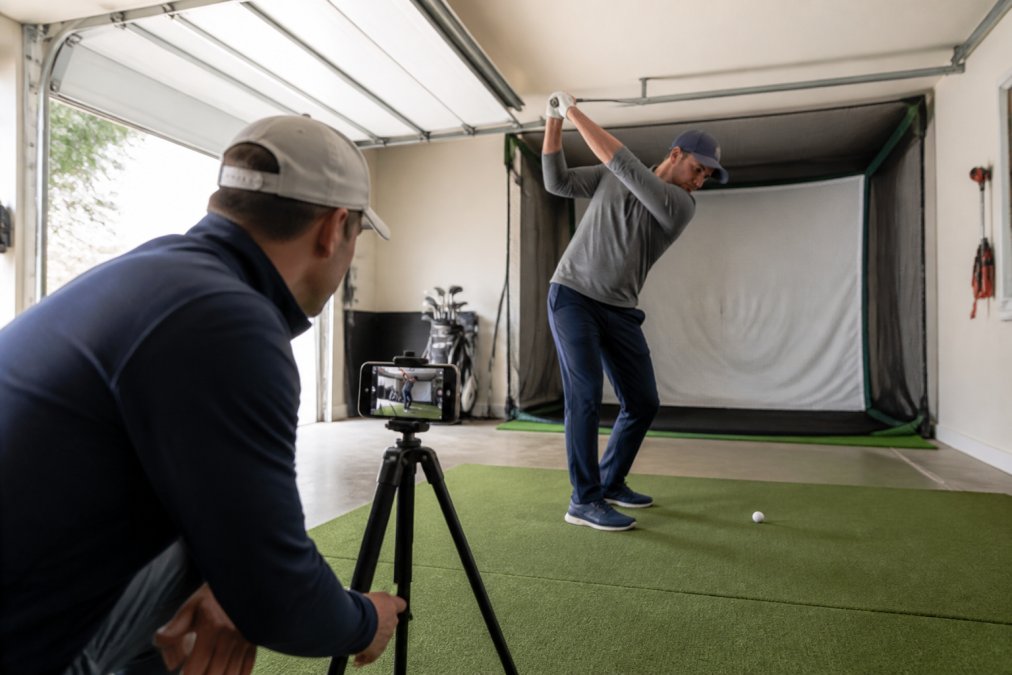
Set up your phone on a tripod at floor level, facing you from the side. Record your driver swing in slow motion. Watch the apex of your backswing and follow-through. Mark the highest point, then measure from the floor to that point.
Add a safety buffer of 4 to 6 inches. That's your real requirement.
If you can't test in the actual room, test outdoors and measure. The number travels with you.
Safety Buffer, Danger Zone, and DIY Ceiling Protection
A safety buffer of 4 to 6 inches above your highest swing point protects your ceiling, your club, and your confidence. Without it, every swing carries a flicker of hesitation, and hesitation ruins your practice.
The danger zone is the vertical band between your clubhead's highest point and the ceiling. Visualize it before every session. If your club enters that band, you are swinging too close to the limit.
Mapping Your Danger Zone
Before you buy padding, map the zone. Stand at your hitting position and hold your driver at the top of your backswing. Have someone mark the ceiling directly above the clubhead with painter's tape. Repeat for the follow-through. The two marks bound your danger zone, the strip of ceiling your club will reach if your swing gets even slightly steeper.
Pad that strip, not the whole ceiling. It is cheaper, lighter, and easier to mount.
DIY Ceiling Protection Options
Several materials work for a home simulator, and they differ in cost, thickness, and how much impact they absorb:
- Closed-cell foam tiles. Common in 1-inch and 2-inch thicknesses, sold in interlocking squares. They absorb a glancing club strike and deaden sound. They are the most popular first layer.
- EVA foam mats. The same material used for gym flooring. Denser than basic foam tiles, so they resist compression better under repeated hits.
- Acoustic panels. Designed for sound, not impact. Useful as a top layer to reduce noise, but they will not stop a clubhead on their own.
- Impact-resistant fabric or netting. Hung just below the ceiling, it catches a clubhead before it reaches drywall and spreads the force across a wider area.
- Plywood or MDF backer board. Mounted above the foam, it distributes a hard strike across joists instead of a single point.
The strongest DIY setup layers these: backer board against the ceiling, closed-cell foam on top of that, and acoustic paneling or fabric as the visible surface. Each layer handles a different failure mode.
Mounting Without Damaging the Ceiling
Adhesive alone is a mistake. Foam tiles peel off in a warm garage and take paint with them. Use a combination of construction adhesive and mechanical fasteners, screws with wide washers into joists, or toggle bolts into drywall where no joist is available. Locate joists first with a stud finder, and mark them before you start.
If you rent, or you want the option to remove the padding later, hang a removable frame from the joists with eye bolts and cable. The frame holds the foam, and the ceiling stays untouched.
What Padding Will Not Do
Foam and acoustic panels absorb impact and reduce noise. They do not replace proper clearance. A full-speed driver strike into a padded ceiling still transfers force into the joists, and repeated strikes will eventually loosen fasteners or crack drywall. Treat padding as insurance against the occasional mishap, not as permission to swing in a space that is too short.
Measure to the lowest obstruction, subtract mat thickness, add a 4-6 inch buffer, and test with slow-motion video. Then pad only the danger zone, layer your materials, and mount with fasteners, not adhesive alone.
Frequently Asked Questions
Is a 9-foot ceiling enough for a golf simulator?
A 9-foot ceiling can work if you are under 6 feet tall, use standard-length clubs, and have a flat swing plane. Measure your swing arc with a launch monitor to confirm. Add a safety buffer of at least 6 inches above your highest point. If your driver or follow-through gets close, consider a shorter driver shaft or a steeper swing adjustment.
What are the safety risks of low ceilings in a golf simulator setup?
Low ceilings increase the risk of clubhead impact, which can damage ceiling joists, light fixtures, or the club itself. A golf simulator ceiling height that is too low also affects your swing mechanics, causing you to alter your natural motion. Install floor padding and ceiling protection like foam tiles to reduce damage. Always test your swing arc before full installation.
How do floor mats and hitting mats affect the minimum ceiling height for a golf simulator?
Thicker hitting mats raise your standing height, reducing overhead clearance. A mat that is 2 inches thick effectively lowers your ceiling by 2 inches. If you are near the minimum, choose a thinner mat or adjust your ceiling protection. Always measure from the top of the mat to the lowest overhead obstruction, not from the bare floor.
Can I use a golf simulator with an 8-foot ceiling?
An 8-foot ceiling is very tight and only works for golfers under 5 feet 6 inches with a flat swing and short clubs. Most drivers require more vertical clearance. You would need to modify your swing significantly or use a limited-flight simulator. For most players, 9 feet is the practical minimum, and 10 feet is recommended for full driver swings.