 blog
Best Golf Simulator for Serious Golfers: 2026 Guide
Table of Contents
- What Separates a Serious Simulator From a Toy
- Radar vs Camera Launch Monitor: Which Tracking Fits Your Swing
- Golf Simulator Space Requirements: Ceiling Height, Depth, and Width
- Best Golf Simulator Software for Data Analysis
- Comparing Serious Golf Simulator Setups Side by Side
- What to Ignore When You Shop for a Golf Simulator
- Conclusion
- Frequently Asked Questions
Last Updated: September 14, 2026
What Separates a Serious Simulator From a Toy
A serious golf simulator is a measurement system first and an entertainment product second. The distinction comes down to data fidelity: how accurately the hardware reads club path, face angle, ball speed, and spin, and how rigorously the software turns those readings into something you can act on. Toys guess. Serious setups measure.
That framing matters because the market blurs the line deliberately. Many packaged systems look impressive in photos but rely on infrared sensors or basic doppler that struggle with high swing speeds and short indoor ball flight. At mygolfsimulator.shop, we help players sort real measurement rigs from dressed-up game consoles, and the gap usually shows up in the first practice session.
Most buyers shopping for the best golf simulator for serious golfers start with budget. That's the wrong first question. Start with what the system must measure, then work backward to the room, the tracking technology, and the software.
Radar vs Camera Launch Monitor: Which Tracking Fits Your Swing
The choice between radar and camera tracking is the single biggest technical decision in a simulator build. Radar systems track the ball through flight using doppler, while camera systems photograph the club and ball at impact from fixed positions. Each favors a different room and a different player.
Radar units measure the full ball flight and work well with longer ball travel, but they need depth behind the ball and can struggle in tight spaces where the ball only travels a few feet before hitting the screen. Camera-based systems capture impact data directly, which makes them more forgiving in short bays and better at reading club path and face angle.
A common mistake is buying a radar unit for a room that can't support it. The data degrades, and the player blames the technology. In practice, camera systems suit tighter indoor bays, while radar rewards rooms with generous depth.
Golf Simulator Space Requirements: Ceiling Height, Depth, and Width
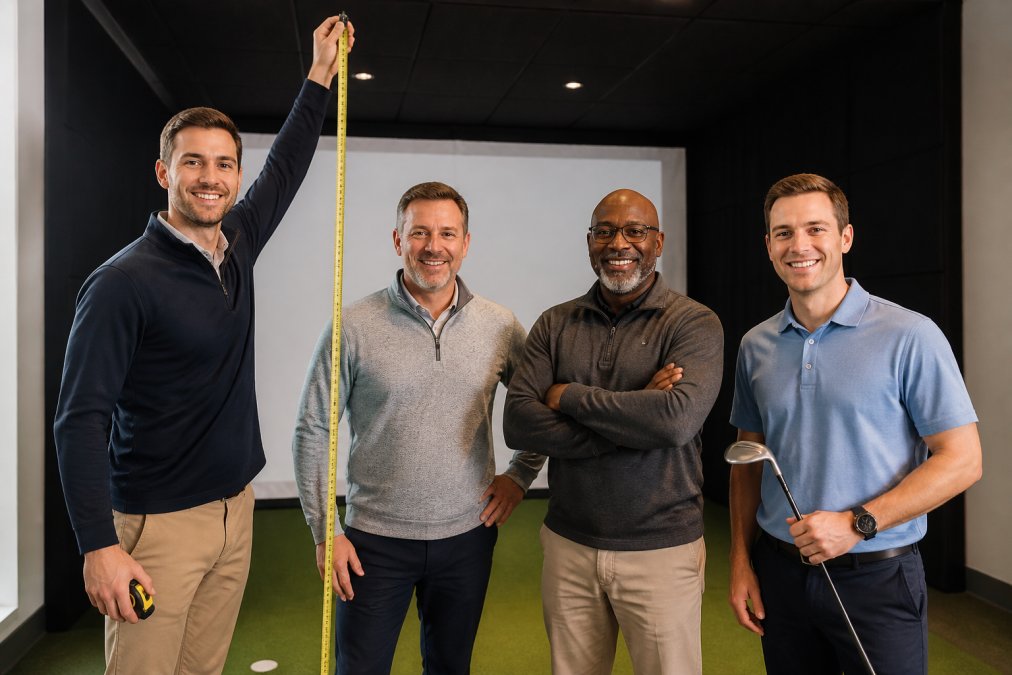
Space requirements decide what's physically possible before any hardware conversation begins. A full-swing simulator typically needs a ceiling around 9 to 10 feet for taller players, roughly 10 to 12 feet of depth from the ball to the screen, and about 10 to 12 feet of width for a comfortable bay. Hitting into a screen rather than a net changes the minimums.
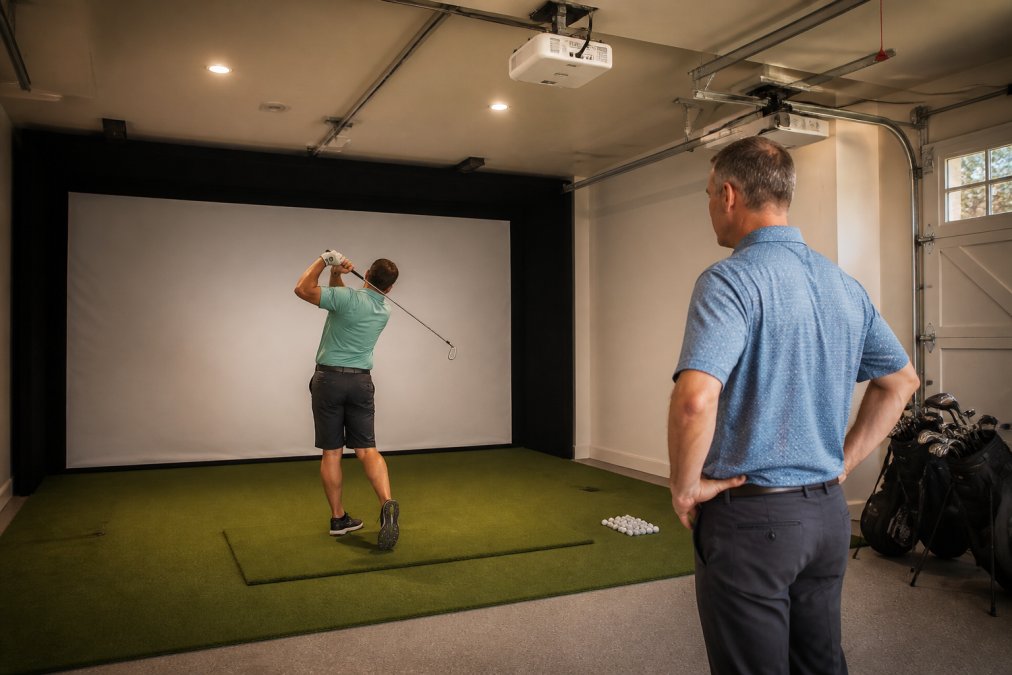
The thing nobody tells you about space is that ceiling height is the hard limit. You can shift a screen, adjust a mat, or move a launch monitor. You cannot easily raise a ceiling. A player with a 9-foot ceiling can often still swing driver by adjusting mat position and using a lower-profile enclosure, but the margin is thin.
Measure your actual swing, not your height. Club length plus arm extension plus follow-through determines clearance, and a driver adds several inches over an iron.
Best Golf Simulator Software for Data Analysis
The best golf simulator software for data analysis is the platform that turns raw launch monitor readings into trends you can review over time, not just a single shot. Good software shows dispersion patterns, club gapping, and session history so you can see whether a swing change is actually working.
Software compatibility is where buyers get burned. A launch monitor that doesn't integrate cleanly with the software you want limits what you can do with your own data. Before buying, confirm the monitor supports the simulation and analysis platforms you plan to use, and get that in writing.
- Dispersion mapping: shows where your shots actually land, not where you think they do
- Club gapping: reveals the real yardage gaps between irons and wedges
- Session history: tracks whether a change holds up over weeks, not one range session
- Course play: adds pressure and decision-making to practice
A monitor with great hardware and weak software integration is a dead end. Match the two before you commit.
Comparing Serious Golf Simulator Setups Side by Side
Serious setups differ less by brand than by configuration. The table below maps the main build types against what each is actually good for, so you can see where your room and goals land.
Setup Type | Tracking | Best For | Space Needs | Data Depth |
|---|---|---|---|---|
Camera-based bay | Photometric cameras | Tight rooms, swing analysis | Moderate depth | High on club data |
Radar-based bay | Doppler radar | Longer ball flight, ball data | Generous depth | High on ball data |
Hybrid system | Radar plus cameras | Full data, flexible rooms | Larger footprint | Highest overall |
Entry full-swing kit | Basic sensors | Casual practice | Minimal | Limited |
The honest read: hybrid systems deliver the most complete data, but they cost more and demand more room. Camera and radar each win in specific conditions. The entry kit is fine for casual play and a poor fit for anyone chasing measurable improvement.
What to Ignore When You Shop for a Golf Simulator
Marketing language is the biggest distraction in this category. Specs like "tour-level accuracy" and "lifelike graphics" mean little without the underlying measurement method and integration details. Ignore the adjectives and ask for the measurement type, the supported software, and the space the system actually needs.
A consultative seller will discourage overspending. If a system offers data you'll never use, or a footprint your room can't support, the right advice is to buy less, not more. That's the approach My Golf Simulator takes: match the equipment to your room and your goals rather than pushing the most expensive option.
The second thing to ignore is the fear of being upsold. A good provider will explain why a cheaper setup fits your space just as readily as why a premium one does. Ask direct questions about compatibility, enclosure quality, and what happens after installation. The answers tell you more than any spec sheet.
Conclusion
The hardest part of building a serious simulator isn't choosing hardware. It's matching tracking technology, software, and room dimensions so the whole system works together, and that's where most buyers go wrong on their own.
My Golf Simulator exists to close that gap. With forty-six years of customer service experience, a consultative approach that matches equipment to your specific room and swing, and ongoing support long after installation, we help you avoid overspending and under-building in the same breath.
Book a consult with mygolfsimulator.shop and get a setup built around your space, your swing, and the data you'll actually use.
Frequently Asked Questions
Is a high-end golf simulator worth the investment for serious practice?
It depends on how you use it. A serious golf simulator gives you year-round reps, accurate ball flight data, and the ability to practice specific shots you cannot hit at a range in winter. The value comes from consistency: daily access to real data beats occasional range sessions. If you train with purpose rather than just play virtual rounds, the setup pays for itself in improved ball striking.
What is the difference between radar and camera-based launch monitors?
Radar units track the club and ball through space, which works well in deeper rooms and gives strong club data. Camera systems capture impact frames directly, so they often read putting and short chips more precisely in tighter spaces. The right radar vs camera launch monitor choice comes down to your room depth, ceiling height, and whether you want club path data or tighter short-game accuracy.
How much space do you need for a professional-grade golf simulator?
A full-swing simulator typically needs a ceiling around 9 to 10 feet for taller players, roughly 10 to 12 feet of depth from the ball to the screen, and about 10 to 12 feet of width for a comfortable bay. Camera-based systems can work in shallower rooms than radar. Golf simulator space requirements vary by tracking type, so measure your ceiling, width, and depth before choosing hardware.
Which golf simulator software offers the most accurate ball flight data?
Accuracy depends on the launch monitor feeding the software, not the software alone. The best golf simulator software for data analysis pairs with a monitor that reads spin, launch angle, and club path reliably, then presents that data in a usable way. Look for software that exports session data and shows shot dispersion, not just pretty courses.